
Finance Minister Nirmala Sitharaman on Tuesday said the interest of all employees of state-owned banks which are likely to be privatised will be protected, even as bank unions observed a two-day strike against the government's privatisation decision. Replying to a query during a press conference, she clarified that public sector presence will continue in the banking space. "...we have announced public enterprise policy based on which we have identified those four areas in which we said government presence, public sector presence will be there, and bare minimum presence is what we have said, in that financial institutions are also there. "Meaning, even in financial sector we will still have the presence of public sector enterprise...not all of them are going to be privatised," she said.

The title 'Navratna' was given originally to nine Public Sector Enterprises (PSEs), identified by the Government of India in 1997, which allowed them greater autonomy to compete in the global market.

RSS-aligned Bharatiya Mazdoor Sangh (BMS) on Monday expressed disappointment over the government's budget proposals with regard to divestment and foreign direct investment, especially in the insurance sector. The BMS, however, lauded the government for its current efforts on the massive vaccination programme, a special scheme for tea workers in West Bengal and Assam, labour oriented push on infrastructure projects in construction sector and development of five major fishing harbours viz. Kochi, Chennai, Visakhapatnam, Paradip, and Petuaghat as hubs for economic activities etc. On other Budget proposals, it said in a statement that "mixing the beautiful concept of Aatmanirbhar Bharat with FDI and disinvestment in the Union Budget is disappointing for the employees".

Shipments of personal computers grew 3.8 per cent on a year-on-year basis to 14.4 million driven by demand for gaming and AI-powered PCs, market research firm IDC said on Monday. IDC India, South Asia and ANZ, associate vice president for devices research, Navkendar Singh said the weakening rupee can lead to an increase in device costs, which can impact the price-sensitive SMB (small and medium businesses) and consumer segments but despite all challenges, the India PC market is most likely to witness a low single-digit growth in 2025.

There is money to buy the central public sector enterprises, but buyers will need a firm assurance that the disvestment programme will keep environment issues front and centre of their corporate plans.
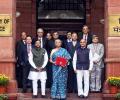
Finance Minister Nirmala Sitharaman on Thursday presented her sixth Budget in a row, equalling the record of former Prime Minister Morarji Desai.

Finance Minister Nirmala Sitharaman on Monday assured the industry that momentum of economic reforms will continue to make India a hotspot of global investment. India has turned the crisis created by COVID-19 pandemic into an opportunity to push the economic reforms, which remained pending for decades, she said while addressing the National MNC's Conference 2020 organised by industry chamber CII.

In the face of scramble for acquiring assets in natural resources like oil, coal and mines by large multi-nationals, the government is working on a policy enabling PSUs to step up search for key raw material assets, Prime Minister Manmohan Singh said.
From a high-profile civil aviation ministry to a relatively low-key Ministry of Heavy Industries and Public Enterprises, Praful Patel is currently busy in launching a multi-pronged strategy for making public sector enterprises globally competitive.

Simplifying GST rates, removing exemptions, easing disputes, and speeding up refunds can boost investment in India and offer the best reply to Trump's tariffs, observes V S Krishnan, former member, Central Board of Indirect Taxes and Customs.

Indian Space Research Organisation's (ISRO's) heaviest rocket LVM3 will launch British start-up OneWeb's 36 broadband satellites from the spaceport in Andhra Pradesh's Sriharikota on October 23, marking the launcher's entry into the global commercial launch service market.

Finance Minister Nirmala Sitharaman on Tuesday said monetisation of Central Public Sector Enterprises (CPSE) assets is based on the principle of value creation for the government and investors and would bring about a paradigm shift in infrastructure augmentation and maintenance. Chairing the National Workshop with the states/UTs on Asset Monetisation organised by Niti Aayog, the minister sought the collaboration of states for the holistic development of infrastructure. She said India can become a $5 trillion economy, while striking the right balance between fiscal imperatives and socio-economic welfare, through active collaboration between the public and private sector.
With tax collections slowing down because of the global economic crisis, the government is looking at non-tax receipts like disinvestment to plug the widening fiscal deficit gap, which last fiscal crossed 6 per cent of the GDP. It can raise significant resources by selling a minority stake of 10 per cent in state-run firms. The Centre can earn at least Rs 37,000 crore by selling up to a 10 per cent stake in the top 10 PSUs in which it owns over 90 per cent.

'The government is actively engaging with EU to ensure that concerns of Indian companies and hard-to-abate sectors are adequately addressed under CBAM'
It is important to generate an attitude that is receptive to technology-based delivery of services.

The government is not in a "crazy rush" to sell everything and it will continue to have a presence in four strategic sectors, including telecom, Finance Minister Nirmala Sitharaman said on Saturday. In strategic sectors, a bare minimum presence of the existing public sector commercial enterprises at the holding company level will be retained under government control. The remaining enterprises in a strategic sector will be considered for privatisation or merger with another PSE or for closure.

Public sector companies did not allow themselves to be bogged down by the global slowdown and kept increasing their investments in 2008-09, the Economic Survey said on Thursday.

In a country where there is such a disparity and large part of population living in villages are below the poverty line, the need for CSR supersedes everything.
The Left Front government in West Bengal will close down two public sector enterprises (PSEs), offload shares in nine PSE to hive them off as joint ventures, retain 13 enterprises and decide on three more using a line of credit from UK's Department for International Development (DFID) worth 23 million pounds.
Does the UPA govt have any other options if it wants to exploit its public sector assets to raise resources and bridge its fiscal deficit?
The Left on Tuesday accused the government of asking central public sector enterprises to raise capital from a sinking stock market and saw a game to hand over their shares to private sector at throwaway prices.

All eyes will be on whether Sitharaman provides the much-expected tax relief for the middle class, leaving more money in their hands, as there is tax buoyancy

The number of times public sector undertakings (PSUs) have held conference calls with investors, their capital management, and debt financing are among the parameters that the Centre will use to judge their performance for the first time, a senior official in the know said. The government will evaluate PSUs for FY22 based on new parameters that were finalised by the Department of Public Enterprises (DPE) in consultation with the Department of Investment and Public Asset Management (DIPAM) last year, the official said. The government had included more conditions in the memorandum of understandings (MoUs) - used to set annual targets - that public sector enterprises sign with the DPE every year. These included a consistent dividend policy, which seeks to transfer dividends by PSUs every quarter; and market capitalisation or share price improvement over the sectoral index on an annual average basis for listed companies.

The SilverLine project, which is expected to considerably reduce travel time from Kasaragod to Thiruvananthapuram, cannot be implemented without approval from the Centre which appears to be giving it a second thought in view of the United Democratic Front and Bharatiya Janata Party's opposition to it, Kerala Chief Minister Pinarayi Vijayan said on Tuesday.
Finance Minister P Chidambaram on Thursday made a double pitch for public sector companies. First he urged private sector companies to enter into joint venture partnership with PSUs
The government is working on a plan to nurse sick public sector units back to health before any disinvestment takes place in these companies, chairman of the PSUs revamp board Nitish Sengupta has said.

Public sector units, which saw a reduction in their head count in 2008-09 due to voluntary retirement schemes, have started hiring again and may return to the 2007-08 level of 15.66 lakh (1.566 million) employees this fiscal, a senior official said.

'We plan to launch new initiatives, including cash flow-based lending, to ensure borrowers are not burdened and can access funds more quickly.'
BRPSE's new chairman Nitish Sengupta has suggested that at least three ailing companies, which have been referred to the board, hive off some of their land and get into real estate development to become profitable again.
Under the impact of the global economic downturn, profit making central public sector enterprises are expected to see an average dip of 15-20 per cent in their earnings in 2008-09, SCOPE's chief Arup Roy Choudhury said.

Adani group is on track to surpass a combined Ebitda (earnings before interest, taxes, depreciation, and amortisation) of Rs 1 trillion in the ongoing financial year (FY25) as it prepares for a $2 billion (over Rs 16,700 crore) share sale by its flagship entity Adani Enterprises next month, according to a source close to the matter.

There is a need for real-time or near real-time credit reporting, instead of the current fortnightly system, to improve underwriting precision, enable timely reflection of borrower actions such as loan closures or repayments, and deliver a superior consumer experience, Deputy Governor of the Reserve Bank of India (RBI), M Rajeshwar Rao said on Wednesday.

The Centre has received Rs 6,651 crore as interim dividend from 12 public sector undertakings (PSUs) on Monday, edging towards its Rs 50,028 crore dividend target for the ongoing fiscal. Power Grid Corporation of India (PGCIL) has transferred Rs 2,506 crore as a dividend tranche to the government, while NMDC and Nuclear Power Corporation of India transferred interim dividend of Rs 1,605 crore and Rs 972 crore, respectively. The government has received dividend tranches of Rs 913 crore from GAIL, Rs 351 crore from Hindustan Aeronautics, Rs 149 crore from Bharat Electronics, among others, Department of Investment and Public Asset Management (DIPAM) secretary Tuhin Kanta Pandey tweeted.
"This money will be used for the revival and modernisation of the PSUs," BRPSE Chairman Nitish Sengupta said. He said instead of providing budgetary support, the option of land sale could be considered for the revival of units in some cases. Elgin Mills in Kanpur, Kolkata-based National Jute Mills, National Textiles Corporation and HMT are among those which have been permitted to sell their surplus lands.
Divestment is the government's mantra to earn big bucks at a time when the country is reeling under a crisis.

In the global context India is looking 'very special'.

Finance Minister Nirmala Sitharaman on Monday said the government has begun an exercise to assess the impact of the pandemic on the economy and likely contraction in GDP, even as she did not rule out the possibility of another stimulus to boost growth.

Apollo Hospitals Enterprise is set to expand presence in metro cities during FY26 with the addition of five hospitals that would add over 1,400 beds.
